[1] "System prompt: "
[2] "You are a member of german parliament. Prepare a summary of the text provided to present at a local community meeting of your party members. Output in german language, no preamble, no extra information, just the plain text. Wordcount maximal 300 words, containing not more than 5% of the keywords of the text provided and explicitly not just a list of keywords but an entertaining text. You are supposed to interprete freely, including background insights on daily politics. Keep in mind thatthe text will be used as is as keynotes to the talk being held to the locals. "
[3] "Text:" gemini paper
1 index
1.1 snc
- 16144.1.pdf
- wks. no fro q.yml
- no.
1.1.1 16145.
- from parent qyml
2 the einleitung
inspired by the paper Empirical evidence of Large Language Model’s influence on human spoken communication, Yakura et al. (2025), who indeed found (evidence) for GPT influenced human language after the introduction of chatGPT we tried to replicate the pipeline of building an AI vocabulary (gpt preferred lemmata) and compare frequencies of gpt-typical words across pre- and post chatGPT human language corpora. The first draft essai proves their hypothesis that LLM generated language manifests within human natural language.
the embedding of that investigation into the context of the class subject germanische sprachen im vergleich is still due; first idea is the projection of the Yakura et al. (2025) findings onto a german language corpus and see if these are still valid although that may rather be a pragmatics investigation.
2.1 preliminary
Our findings are still limited to a yet very small corpus of texts after the introduction of the google gemini chat agent to the german public in 03/2024, cf. Wikipedia and Google (2026). In contrast to Yakura et al. (2025) and out of resources considerations we decided for gemini as basis for our AI generated vocabulary and for another text corpus (german bundestag plenary protocols, DIP (2026)) than youtube/podcast audio for the same reasons. That limits our post-AI corpus to a small timeframe between 03/2024 up to now. With expanding that corpus to a wider spectrum with including other sources we may harden our results.
3 hypothesis
following Yakura et al. (2025) we assumed that the consuming of LLM generated language influences the human production of language such that vocabulary typical for LLM output will be found with higher frequencies in human language corpora dating after chat agent introduction.
4 methods
4.1 snc
16062.1.2.16063.1
please cf. Schwarz (2026) for the corpus building and evaluation script (still messy.)
4.2 data
our human langugae data consists of raw texts from german bundestag plenary protocols (DIP (2026)). the LLM corpus consists of model summaries of a first subset of these texts generated with the following prompt: Section 4.2.2.
4.2.1 corpus subsets
| target | tokens |
|---|---|
| gemini | 3866 |
| human-pre | 1640446 |
| human-post | 1940385 |
4.2.2 gemini prompt
4.3 computation
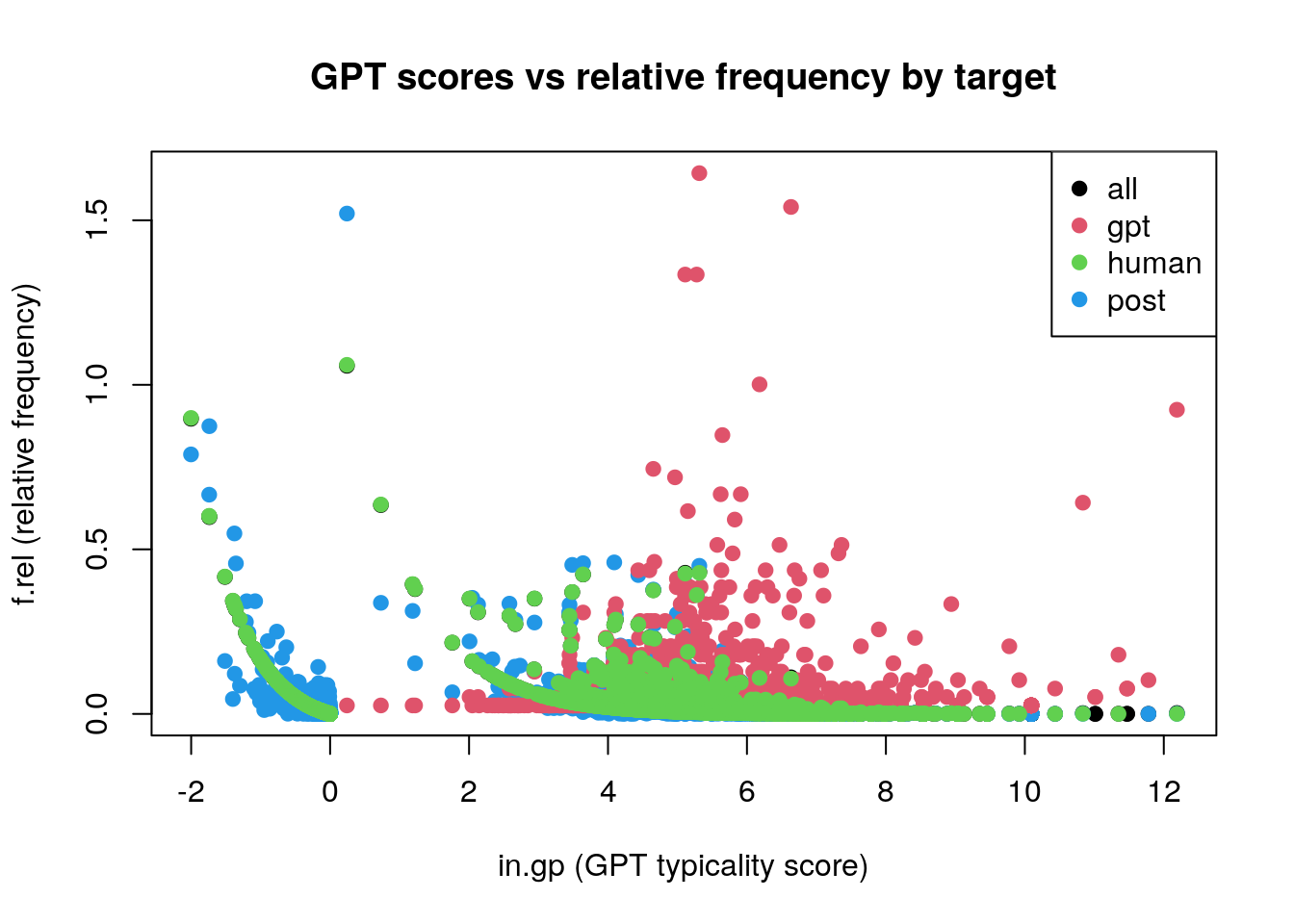
we first devised AI-typical lemmata in the model corpus which are distinct for that corpus by log frequency calculation, see Figure 1
5 evaluation
5.1 basic descriptive
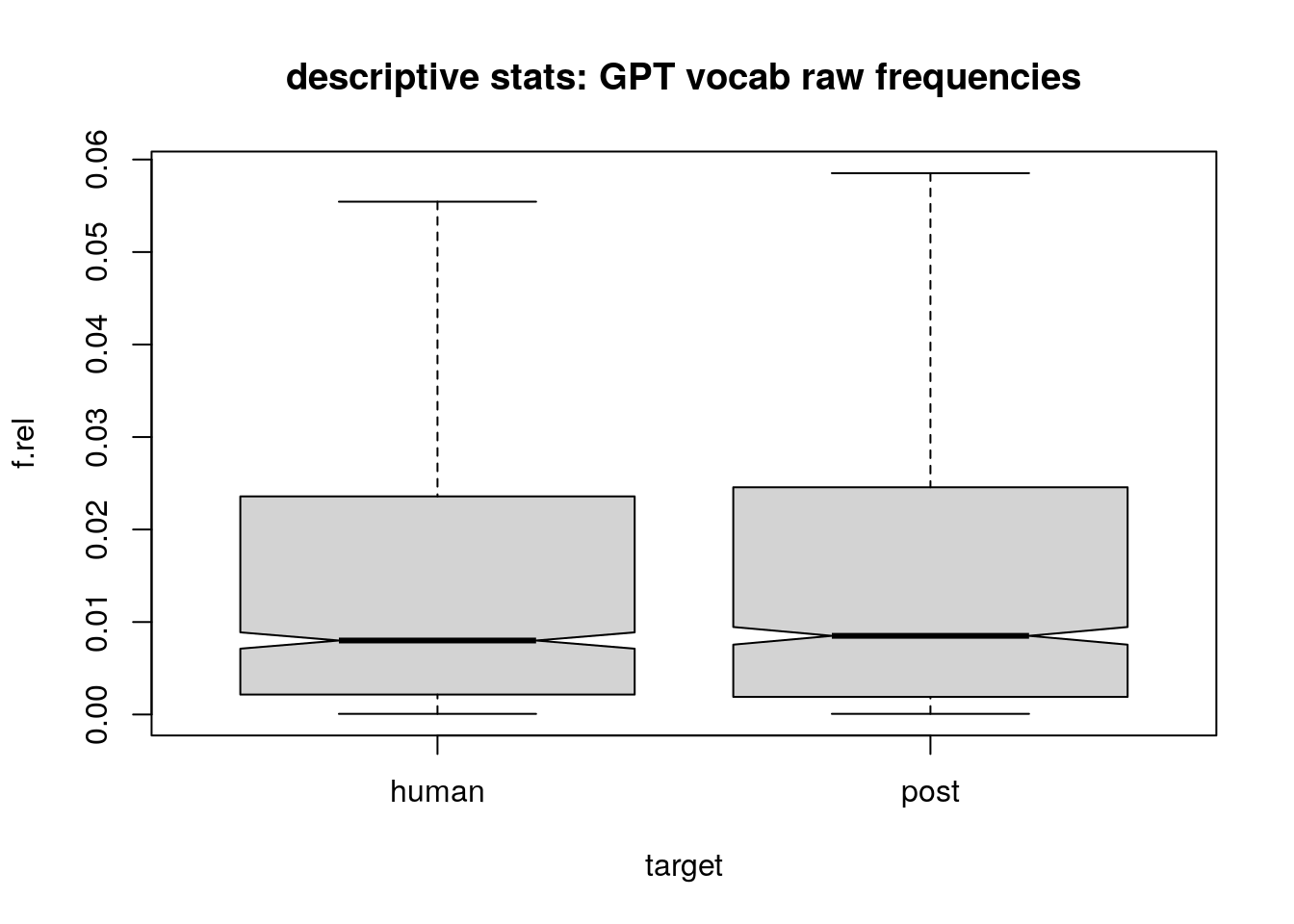
to first gather an insight, yet with simple descriptive stats comparing the raw frequencies of gpt-preferred lemmas in pre- and post-gemini onset we find that in the target corpus the occurences of these lemma increase, only by small amount (see Table 1) and hard to visualise (see Figure 2). wether these findings become relevant, we’ll see in Section 5.3 where we evaluate the frequencies with a linear regression model.
| target | freq |
|---|---|
| pre | 0.4384 |
| post | 0.4414 |
| DIFF: | 0.0030 |
5.2 responsible lemmata
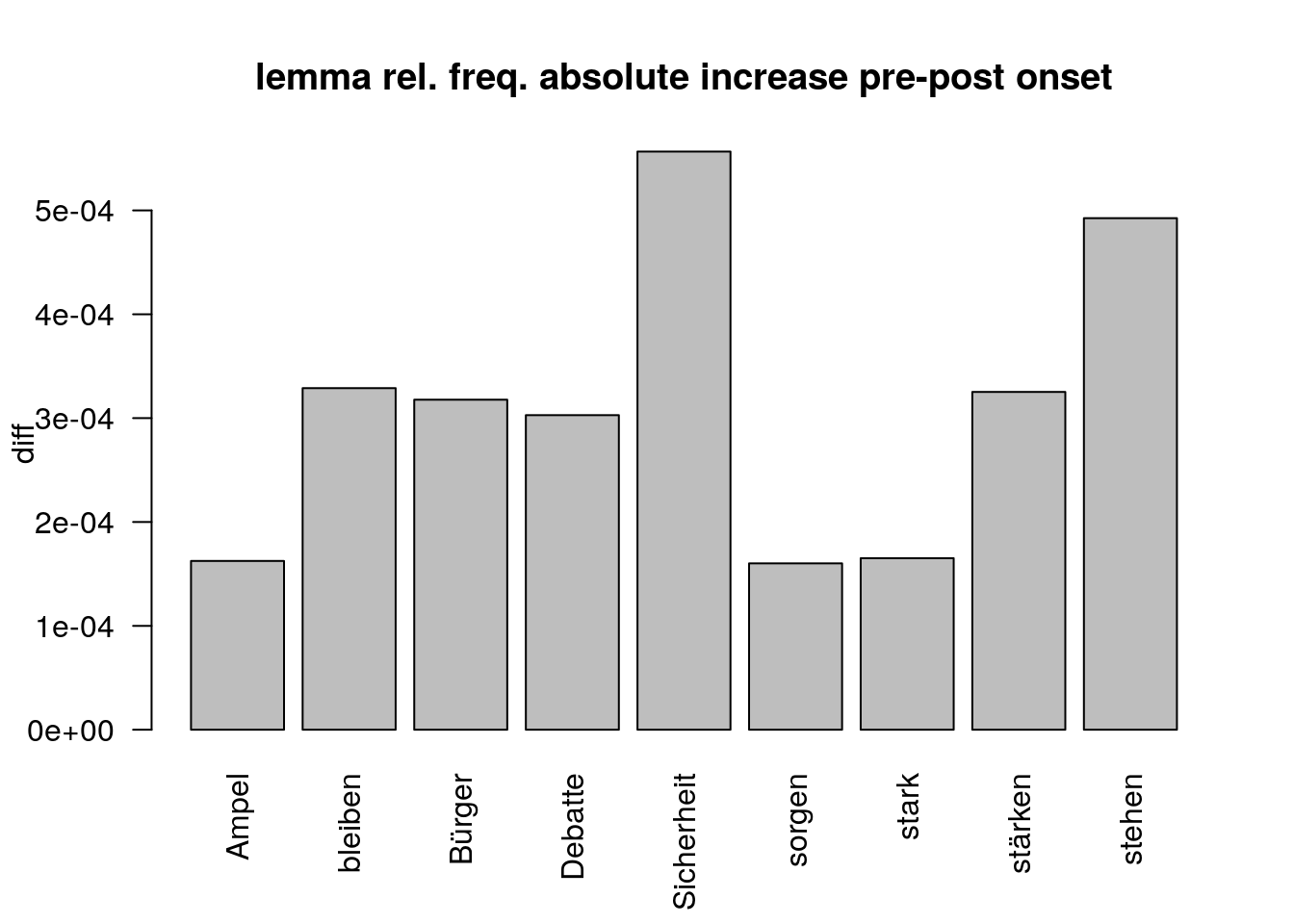
The 9 lemma where 1. the relative frequency of lemma in target=post is higher than in target=pre (n=27) and 2. that frequency exceeds the mean relative frequency is displayed in Figure 3.
5.2.1 lemma descriptive output
5.2.2 lemma linear model output
5.3 linear regression
to prove descriptive results, we compute the stability of the frequency increase for target- vs. reference corpus with a linear regression model using R’s lme4::lmer() function, cf. Bates et al. (2015). coefficents are printed below, where freq_pmw is the lemma frequencies/pmw over corpus; post defines reference resp. target corpus [post==TRUE|FALSE] (pre/post) and gp as numerical variable representing the gpt-score of the corresponding lemma i.e. wether it scores high (positive values) or low (negative values) in terms of being preferredly used by the chat agent.
5.3.1 basic (lm)
formula: frequency.pmw ~ post + gpt.score
Call:
lm(formula = freq_pmw ~ post + gp, data = df_lg.norm)

Residuals:
   Min     1Q Median     3Q    Max
 -1400   -435   -388   -243 436922

Coefficients:
            Estimate Std. Error t value Pr(>|t|)
(Intercept)   833.75      38.64  21.576  < 2e-16 ***
postTRUE       83.94      20.64   4.067 4.77e-05 ***
gp             68.11       5.20  13.097  < 2e-16 ***
---
Signif. codes:  0 '***' 0.001 '**' 0.01 '*' 0.05 '.' 0.1 ' ' 1

Residual standard error: 3765 on 133087 degrees of freedom
  (1393 observations deleted due to missingness)
Multiple R-squared:  0.0014,    Adjusted R-squared:  0.001385
F-statistic: 93.32 on 2 and 133087 DF,  p-value: < 2.2e-16
5.3.2 random effects model (lmer)
formula: frequency.pmw ~ post + gpt.score + (1|lemma)
Linear mixed model fit by REML. t-tests use Satterthwaite's method [
lmerModLmerTest]
Formula: freq_pmw ~ post + gp + (1 | lemma)
   Data: df_lg.norm

REML criterion at convergence: 2490672

Scaled residuals:
    Min      1Q  Median      3Q     Max
-48.624  -0.047  -0.032   0.008  74.360

Random effects:
 Groups   Name        Variance Std.Dev.
 lemma    (Intercept) 8839356  2973
 Residual             1754704  1325
Number of obs: 133090, groups:  lemma, 99649

Fixed effects:
             Estimate Std. Error        df t value Pr(>|t|)
(Intercept) 4.344e+02  3.966e+01 1.055e+05  10.953   <2e-16 ***
postTRUE    1.246e+02  9.496e+00 5.602e+04  13.126   <2e-16 ***
gp          2.932e+01  5.723e+00 1.017e+05   5.124    3e-07 ***
---
Signif. codes:  0 '***' 0.001 '**' 0.01 '*' 0.05 '.' 0.1 ' ' 1

Correlation of Fixed Effects:
         (Intr) psTRUE
postTRUE -0.110
gp        0.959  0.009
3 x 3 Matrix of class "corMatrix"
(Intercept) postTRUE gp
(Intercept) 1.0000000 -0.110159806 0.959345449
postTRUE -0.1101598 1.000000000 0.008711618
gp 0.9593454 0.008711618 1.0000000005.3.2.1 helper interpretation, to be tested
the coefficients interesting for us are the gp and post estimates. here we test the association between the gpt score of a lemma and its estimated frequency and its showing that a general increase of frequency is estimated if the score rises (=the lemma is within the lemmas preferred used by gemini) and that for the post-gpt corpus this increase (6.75072%) is significant for single lemmata (and not random in data).
in the fixed effects correlation output of the lmer() model we see that the gpt score correlates with the target corpus frequency for lemma by 1.
5.3.3 anova of mixed effects model [out]
6 references
Bates, Douglas, Martin Mächler, Ben Bolker, and Steve Walker. 2015. “Fitting Linear Mixed-Effects Models Using Lme4.” Journal of Statistical Software 67 (1): 1–48. https://doi.org/10.18637/jss.v067.i01.
DIP. 2026. “DIP - Bundestagsprotokolle.” Docs. DIP - API. Berlin. https://dip.bundestag.de/%C3%BCber-dip/hilfe/api#content.
Schwarz, St. 2026. “This Papers Corpus Build & Evaluation Scripts.” GitHub/Esteeschwarz. Berlin. https://github.com/esteeschwarz/SPUND-LX/blob/main/germanic/HA/.
Wikipedia, and Google. 2026. “Google Gemini.” Wikipedia. https://de.wikipedia.org/w/index.php?title=Google_Gemini&oldid=263426206.
Yakura, Hiromu, Ezequiel Lopez-Lopez, Levin Brinkmann, Ignacio Serna, Prateek Gupta, Ivan Soraperra, and Iyad Rahwan. 2025. “Empirical Evidence of Large Language Model’s Influence on Human Spoken Communication.” arXiv. https://doi.org/10.48550/arXiv.2409.01754.